A school playground is much more than just a place for break time. It’s a space where children move, play together, unwind and explore. Yet the question “What are good ideas for a school playground?” is often answered too quickly with a few individual play structures or a single fixed concept. A truly successful playground, however, is created through thoughtful and well-considered choices.
In this blog, we outline the key ideas, explaining why they work and how to combine them effectively. It all starts with understanding how children actually use a playground.
Children don’t all play in the same way. Some seek movement and challenge, while others look for calm, overview, imagination or social play. When we think about different play styles, we distinguish between Energizers, Structure seekers, Builders and Observers. Energizers crave action and speed, Structure Seekers look for physical challenge and movement, Builders are driven by creativity and imagination, Observers need calm, structure and places to watch. A playground works best when it brings together multiple forms of play. Offering choice allows every child to find a place that suits their own way of playing. In practice, we see that well-loved and well-used school playgrounds consistently include five key elements. Together, these create balance, variety and enjoyment. A school playground should invite movement at different levels. Variety and open-ended play prompts allow children to decide for themselves how intensively they want to move. Changes in height, diversity and freedom make movement appealing and natural. Natural elements make a playground more versatile and calming. They encourage play that isn’t fixed and can change every day. Green spaces invite exploration, experimentation and cooperation. Alongside movement, children also need places to retreat or spend time together quietly. Clear sightlines and sheltered areas help the playground feel pleasant and safe. These spaces support calm and social connection. Play often emerges where not everything is predefined. Open spaces and simple play prompts give children the freedom to invent their own games. This makes the playground flexible and suitable for different ages. A good school playground invites everyone to join in. With a clear layout, logical routes and play elements that encourage cooperation, children feel welcome. Inclusion is found in the overall coherence of the space. Good ideas are a strong starting point, but a playground only truly works when everything comes together as a whole. The space, the children, daily use and the school’s wishes all require a tailored approach. What seems logical on paper can work very differently in practice. That’s why we help schools translate their ideas into a well-thought-out and fitting playground design. We’re happy to visit and observe how the playground is currently used, where opportunities lie, and how different forms of play can strengthen one another. From there, we work step by step towards a design that suits the school, the children and the available space.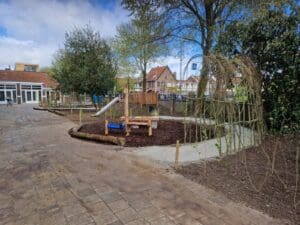
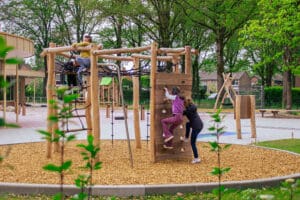
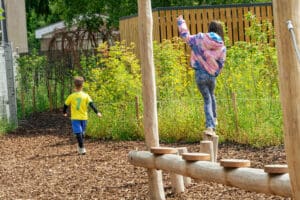
1. Movement and physical challenge
Examples include:
– climbing and scrambling elements
– balance routes and stepping stones
– space for running and free play2. Natural play and exploration
Think of:
– small hills, shrubs and tree trunks
– loose natural materials
– sand and water elements3. Calm, overview and social interaction
Useful features include:
– seating and benches
– semi-enclosed corners
– spots with a clear view of the playground4. Free play and flexibility
Examples include:
– open play surfaces
– ground markings for games
– multi-functional play elements5. Playing together and inclusion
This means:
– accessible pathways
– play areas that promote playing together
– smooth transitions between different zonesFrom ideas to a playground that truly works